

Primary Program
"The child is both a hope and a promise for mankind.”
- Maria Montessori
Hands-on Learning in a Child-Centered Environment
Do you hope to ignite your child’s love of learning and lay the foundation for a fulfilling future of education? In our Montessori Early Childhood classrooms, children thrive in a joyful, secure, and nurturing environment designed to foster curiosity, independence, and confidence.
Our child-centered classrooms nurture connected community while gently weaving elementary school-readiness throughout the curriculum.
Exploration and Independence

In each of Jarrow's four Primary classrooms, children ages 3-6 are encouraged to explore, discover, and take ownership of their learning.
The Montessori approach promotes self-directed learning, helping children develop critical thinking, independent action, and social-emotional skills. Education for peace is a cornerstone of the curriculum: children learn respect for others and the environment, gain tools for peaceful conflict resolution, and begin to understand social responsibility and global citizenship.
Mixed-age classrooms foster peer learning, collaboration, and confidence, allowing children to learn from and support one another as they grow. Every activity is purposeful, guiding children to become independent, capable, and joyful learners.
Dynamic, Engaging Primary Curriculum
Our Primary (preschool) classrooms provide a joyful, nurturing environment where young learners thrive and develop curiosity and confidence in their classrooms. Teachers carefully observe each child, guiding lessons based on individual interests and abilities, while offering encouragement, time, and materials to let natural curiosity drive learning. Our students are often free to choose activities, work independently or with a partner, and progress at their own pace—developing patience, focus, and self-control along the way.
The Jarrow Primary program embraces mixed-age classrooms, where first-year students learn by observing older learners, while second and third-year students deepen understanding by mentoring younger learners. This dynamic builds confidence, leadership, empathy and a strong sense of community in the classroom. Our teachers deeply know and care about each child as they guide them through their 3-year time in the early childhood phase of their Montessori education.
Our 3-6 year olds develop a sense community, confidence, and deep social connections with their peers, many of whom they share a classroom with for 2-3 years.
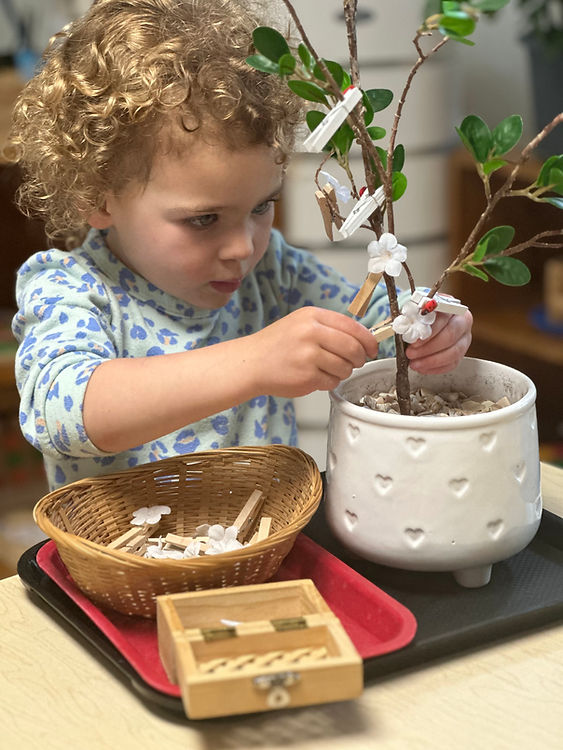
Capable, Curious Learners
Our Primary classrooms are carefully prepared to support the young child’s “absorbent mind.” Hands-on sensorial and academic materials spark curiosity, invite concentration, and build foundational skills across all areas:
The Primary curriculum introduces five key areas of study:
-
Practical Life: Daily-life skills like dressing, preparing snacks, caring for the classroom, and practicing kindness and courtesy.
-
Sensorial: Hands-on experiences that refine the senses and help children classify, sort, and make sense of the world.
-
Math: Exploring numerals, quantities, patterns, and operations through concrete materials to build a deep understanding.
-
Language: Developing vocabulary, writing, reading, and communication through engaging, hands-on activities.
-
Cultural Studies: Exploring science, geography, history, art, and music to foster curiosity, respect, and awareness of the wider world.
Mixed-age classrooms encourage collaboration, peer learning, and a sense of community. Over the three-year Early Childhood cycle, children develop concentration, decision-making, independence, and social-emotional skills. In Montessori education, academic growth is just one part of the whole-child approach—nurturing intellectual, social, emotional, and physical development in a supportive, joyful environment.
The Third Year of Primary:
The Kindergarten Year
In their third or final year in an early childhood classroom— often referred to as the Kinder year—Jarrow learners step into leadership roles within their Primary classroom. Having spent their first two years building independence and foundational skills, in their third year, they take pride in guiding younger peers, modeling behavior, and reinforcing their own learning by teaching concepts they have already mastered. This is a year of remarkable growth, confidence, and responsibility.
Kindergarten students at Jarrow spend their morning with their Primary class, then take special pride in having a unique afternoon Kindergarten program with their peers from across all 4 of our Primary classrooms.
The afternoon Kinder program allows them access to a larger peer group, more collaborative learning and socialization with their same-age peers as they build skills, friendships, and confidence before moving into our Lower Elementary program as first graders. It is a year of empowerment and confidence, preparing your child not only for first grade, but for a lifetime of curiosity, responsibility, and joy in learning.

Why the Kinder Year Matters
Kinders continue to explore more advanced Montessori materials and lessons across language, math, science, geography, and cultural studies. They revisit familiar activities with greater depth, solidifying knowledge and experiencing the satisfaction of mastery. Working with sustained attention on multi-step projects, they develop:
-
Academic Confidence: Children use their strong foundation to explore more complex math operations, reading fluency, and writing projects.
-
Leadership and Mentorship: As the oldest students in the class, they take pride in guiding and modeling for younger peers, solidifying their understanding through teaching.
-
Independence and Responsibility: They gain self-direction, time management, and the ability to complete multi-step work over days or weeks.
-
Joy in Mastery: With sustained attention and increasing ability, children find satisfaction in hard work and problem-solving.
Our smaller class sizes and classroom materials allow for extensive differentiation within subjects - creating a “learn at your own pace” environment where students who have mastered concepts can move well ahead of typical grade-level in some areas, and other students can engage in small-group and 1:1 instruction, increasing their mastery of challenging curriculum at an approachable pace.

"I am so impressed by the personalized attention and creativity in the Kinder program at Jarrow. The collaboration between parents and teachers feels like true teamwork—it’s an incredible experience to be part of."
- Jarrow Kindergarten Parent